Can Medicare Revoke a Practice’s Enrollment Over Denied Claims Under the New 2027 Rule?
CMS removed the factors it once weighed before revoking providers for a pattern of noncompliant claims, made revocations retroactive and cut the
Read the articleEmail: info@webillhealth.com | Call: +1 (425) 818 9351
Business hours: Monday to Friday, 8am to 9pm EST
California Medi-Cal
A Medi-Cal provider number on the Provider Master File, a revalidation answered in time, and claims that keep paying.
California Medicaid, called Medi-Cal, is run by the Department of Health Care Services (DHCS), whose Provider Enrollment Division enrolls about 300,000 fee for service providers. In June 2026 DHCS told CMS it would revalidate higher risk providers off cycle over two years, on a clock that starts with a 35 day notice. The application fee page and the PAVE questions set out the rest.
Application fee
$750 for calendar year 2026, up $20 from 2025, for institutional applicants; physician and practitioner groups and individuals pay none. DHCS, Application Fees
Revalidation notice
35 days to say whether the provider will revalidate or withdraw; no answer means automatic termination and deactivation. DHCS letter to CMS, Provider Revalidation Strategy, June 5, 2026
Revalidation filing
A complete application within 70 days of the instructions, then up to 180 days of DHCS review and 60 days to correct deficiencies. DHCS letter to CMS, Provider Revalidation Strategy, June 5, 2026
Change reporting
Ownership, service location and practice site changes are reported within 35 days, and each one triggers an off cycle revalidation. DHCS letter to CMS, Provider Revalidation Strategy, June 5, 2026
Deficient applications
A deficiency letter gives 60 days to correct and resubmit; a submitted application cannot be edited while DHCS has it. DHCS, PAVE Frequently Asked Questions
Medicare revalidation
Revalidating with Medicare does not satisfy the Medi-Cal revalidation requirement. DHCS, PAVE Frequently Asked Questions
What we see in practice
45 to 90 days from submission to an active Medicaid ID.
Providers must respond within 35 days indicating whether they
The application fee amount for the calendar year 2026 is $750.00.
On June 5, 2026 DHCS answered a CMS request for a two year plan to revalidate higher risk providers. DHCS letter to CMS, Provider Revalidation Strategy, June 5, 2026 DHCS letter to CMS, Provider Revalidation Strategy, June 5, 2026 The letter describes a continued enrollment process that California has used since August 2015, when it began requiring providers to report changes in ownership, service location or practice sites within 35 days, each of which triggers an off cycle revalidation. DHCS letter to CMS, Provider Revalidation Strategy, June 5, 2026 DHCS letter to CMS, Provider Revalidation Strategy, June 5, 2026 DHCS letter to CMS, Provider Revalidation Strategy, June 5, 2026
The process has five steps. DHCS sends a written notice, and the provider has 35 days to say whether it will revalidate or withdraw; silence means automatic termination and deactivation. DHCS letter to CMS, Provider Revalidation Strategy, June 5, 2026 DHCS letter to CMS, Provider Revalidation Strategy, June 5, 2026 DHCS then issues application instructions, which it has promised to send within 30 days instead of the 180 days state regulation allows. DHCS letter to CMS, Provider Revalidation Strategy, June 5, 2026 The provider files a complete application within 70 days of the instructions, or is terminated. DHCS letter to CMS, Provider Revalidation Strategy, June 5, 2026 DHCS letter to CMS, Provider Revalidation Strategy, June 5, 2026 DHCS may take up to 180 days to review, and the provider gets 60 days to correct any deficiency. DHCS letter to CMS, Provider Revalidation Strategy, June 5, 2026 DHCS letter to CMS, Provider Revalidation Strategy, June 5, 2026 A provider that withdraws is disenrolled at once, with every service location deactivated. DHCS letter to CMS, Provider Revalidation Strategy, June 5, 2026
The plan runs in phases: continued revalidation from June to December 2026, then acceleration for higher risk categories from January 2027 to June 2028, starting with durable medical equipment, Drug Medi-Cal and clinical laboratories. DHCS letter to CMS, Provider Revalidation Strategy, June 5, 2026 DHCS letter to CMS, Provider Revalidation Strategy, June 5, 2026 DHCS letter to CMS, Provider Revalidation Strategy, June 5, 2026 DHCS says it will rely on Medicare screening results where it can, and that the whole effort supplements, rather than replaces, the federal five year revalidation requirement. DHCS letter to CMS, Provider Revalidation Strategy, June 5, 2026 DHCS letter to CMS, Provider Revalidation Strategy, June 5, 2026 42 CFR 455.414 The department's June 8 stakeholder news summarised the commitment as revalidating higher risk providers swiftly under a two year plan. DHCS Stakeholder News, June 8, 2026 DHCS Stakeholder News, June 8, 2026

An approved provider lands on the Provider Master File that claims payment runs against, DHCS, Provider Enrollment Division which is why a Medi-Cal number that is not yet active cannot pay a claim, and why we plan around 45 to 90 days from submission to an active Medicaid ID in California.
Enrollment is not a one time filing in California. Under the federal Consolidated Appropriations Act, 2023, enrolled providers review and update their directory information every quarter. DHCS, Provider Enrollment Division Changes in ownership, service location or practice site must be reported within 35 days, and each report starts an off cycle revalidation. DHCS letter to CMS, Provider Revalidation Strategy, June 5, 2026 DHCS letter to CMS, Provider Revalidation Strategy, June 5, 2026
Revalidation itself is requested by DHCS, and the online application handles it for supported provider types. DHCS, PAVE Frequently Asked Questions A revalidation done with Medicare does not carry over: the FAQ says plainly that it does not meet the Medi-Cal requirement. DHCS, PAVE Frequently Asked Questions
A provider that wants out can request deactivation online. DHCS, PAVE Frequently Asked Questions The fee amount moves every year, as the $730 figure for 2025 and the $750 for 2026 show, so a revalidating institutional provider budgets for the year of submission. DHCS, Application Fees DHCS, Application Fees
The first loss is a missed window. Every step of continued enrollment has a deadline that ends in termination when missed: 35 days to answer the notice, 70 days to file a complete application, 60 days to fix a deficiency. DHCS letter to CMS, Provider Revalidation Strategy, June 5, 2026 DHCS letter to CMS, Provider Revalidation Strategy, June 5, 2026 DHCS, PAVE Frequently Asked Questions Once the application is with DHCS it cannot be edited, so a mistake found after submission waits for the deficiency letter. DHCS, PAVE Frequently Asked Questions
The second is the fee itself. An institutional application sent without the right year's fee is not an applicable submission, and the submission date is the postmark or the online submission date. DHCS, Application Fees DHCS, Application Fees
The third is the directory. Quarterly updates are a condition of staying listed, and an unreported move or ownership change is both a 35 day violation and the trigger for an unplanned revalidation. DHCS, Provider Enrollment Division DHCS letter to CMS, Provider Revalidation Strategy, June 5, 2026
WeBill Health runs Revenue Velocity Credentialing with 24/7 CAQH and PECOS lifecycle monitoring, so revalidation dates and affiliation gaps are caught before they become suspended claims. Every file gets Human Expert Review from a credentialing specialist before it goes to the California Department of Health Care Services.
WeBill Health manages the full payer enrollment lifecycle, so your revenue cycle starts the moment your practice does.
less payer enrollment lag against the industry baseline
CAQH and PECOS lifecycle monitoring
Each neighboring state issues its own Medicaid ID under its own rules and timelines.
See every state on Medicaid provider enrollment by state. If California providers are seeing patients before a Medi-Cal number is active, read Revenue Velocity Credentialing.
Reviewed by James Whitaker, Credentialing Lead, on November 11, 2026. Facts verified November 11, 2026.
The Revenue Defense Audit is a free, forensic review of your claims and A/R by the team that would work your account, including providers waiting on Medi-Cal approval or facing an off cycle revalidation.
Want a quick read first? Check my Revenue Defense Score for the credentialing and denial exposure in your specialty.
CMS removed the factors it once weighed before revoking providers for a pattern of noncompliant claims, made revocations retroactive and cut the
Read the article →
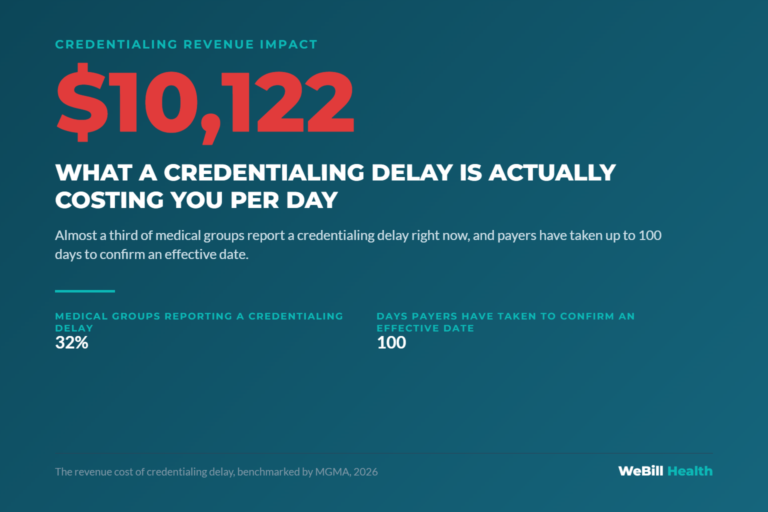
A one day delay in credentialing a new provider costs a medical group roughly 10,122 dollars in lost billing capacity, according to
Read the article →Find the three denial patterns costing you most, trace each to its cause with the CARC code map, and close it at source. Appeal deadline table, checklist and worksheet included.
Before you go
Find the three denial patterns costing you most, trace each to its cause with the CARC code map, and close it at source. Appeal deadline table, checklist and worksheet included.