WeBill Health

Business hours: Monday to Friday, 8am to 9pm EST

Specialty revenue defense

Orthopedic Billing Services

Neutralizing Bundling Errors and Defending Global Surgical Yield.

Orthopedics is the highest volume surgical specialty in the U.S., yet it faces the most aggressive "Shadow Bundling" in the 2026 payer landscape. With the transition of many procedures to Ambulatory Surgery Centers (ASCs) and the introduction of the 2026 CMS -2.5% Efficiency Adjustment, orthopedic margins are under technical siege. Generic billing companies often fail to distinguish between "Staged" (Modifier 58) and "Unplanned" (Modifier 78) returns, or they misapply Modifier 51, leading to a "Multiple Procedure Penalty" that shouldn't exist. At WeBill Health, we treat your surgical cases with forensic precision, ensuring every implant, brace, and global visit is captured and paid.

The Orthopedics Forensic Leakage Map

If your practice is seeing high denial rates or "Bundled" line items, you are likely suffering from these three technical leakage points:

  1. The Global Period "Ghost" Visits (Modifier 24/25/79)

    The technical challenge

    Major orthopedic surgeries have 90-day global periods. Payers utilize AI scrubbers to automatically deny any E/M visit or minor procedure (like an injection) performed during this window. If a patient returns for an unrelated issue (e.g., knee pain during a hip recovery), the claim must carry Modifier 24. If it's a new injury, it requires Modifier 79.

    The revenue impact

    Without technical oversight, these "unrelated" visits are written off as "included in the global fee," costing a multisurgeon group over $150,000 annually in lost E/M and diagnostic revenue.

  2. The Multiple Procedure "Shadow" Bundle (Modifier 51 vs. 59)

    The technical challenge

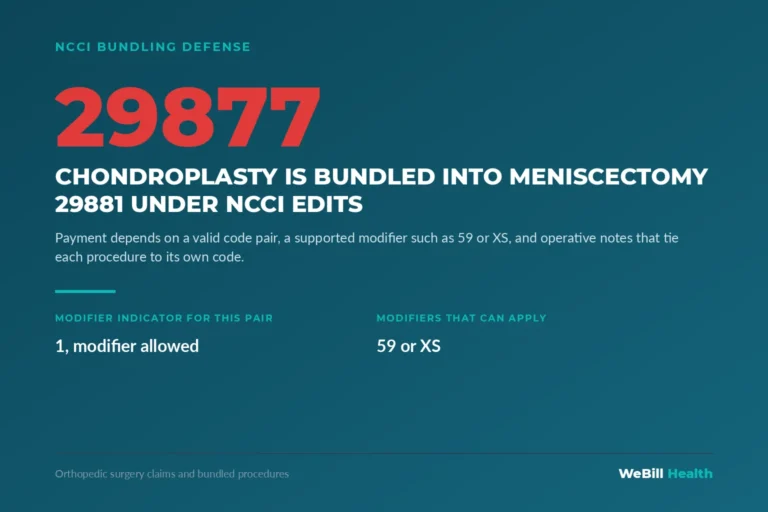
    Orthopedic surgeons often perform multiple procedures (e.g., an ACL repair with a meniscectomy). Payers frequently apply a "Multiple Procedure Discount" (Modifier 51) to services that should actually be billed as "Distinct" (Modifier 59/XS). In 2026, the misuse of these modifiers triggers a 12 to 18% loss in annual surgical value.

    The revenue impact

    If a secondary procedure is bundled into the primary code's fee, you lose 50% to 100% of the reimbursement for that work. This is particularly prevalent in arthroscopic cases where "debridement" is incorrectly bundled into the "repair" code.

  3. DMEPOS & 7th-Character ICD-10 Erosion

    The technical challenge

    Orthopedics relies heavily on DME (braces, orthotics) and injury specific coding. In 2026, the DMEPOS Competitive Bidding Program (CBP) updates require strict "Bona Fide Bids" and physician signed "As Prescribed" branding. Furthermore, failing to append the correct 7th character (A for initial, D for subsequent, S for sequela) triggers an automatic "Documentation Mismatch" denial.

    The revenue impact

    DME revenue has a 20% higher denial rate than surgical claims due to missing "Delivery Tickets" or "Physician Orders." For a practice dispensing 50 braces a month, this represents a $30,000 annual leak.

The WeBill Health Defense for Orthopedics

We engineer a defense against payer attrition.

  • 2026 Site of Service OptimizationFollowing the CMS shift (Facility -7%, NonFacility +4%), we optimize your billing for the ASC and Office settings. We ensure your "Professional Component" captures the maximum yield under the new 2026 Indirect Cost methodology.
  • Global Window TrackingOur coding experts track every patient’s "Global Clock." If a surgeon bills an E/M or injection during a 90-day window, our coding experts audit the ICD-10. If the diagnosis is unrelated, they append Modifier 24/79 before submission to prevent the "Global Bundle" denial.
  • "Level of Detail" ICD-10 AuditWe eliminate the "M17.9 (Unspecified Osteoarthritis)" trap. Our Clinical VMAs flag any claim missing a 7th character or laterality (Left/Right/Bilateral), ensuring your documentation meets the 2026 "Specificity Threshold."
  • DMEPOS Compliance GuardrailsWe match your "Delivery Tickets" to your "Physician Orders" before every DME claim goes out. Our coding experts confirm that DME26-A fee schedule amounts are correctly applied and that all "Prior Auths" are linked to the specific brace or implant used.

Our Performance Standards

98%

Clean claim rate on the claims we submit.

48 hours

Submission guarantee on every clean claim.

40%

A/R reduction within 90 days.

Every Orthopedics claim, reviewed by an expert before it leaves

The same specialty team owns each claim from the first code to the final payment. Every claim is reviewed by an expert against your payer rules before it goes out.

You see where each one stands in your weekly velocity report.

  1. Eligibility verifiedCoverage and benefits confirmed before the visit.
  2. Encounter codedSpecialty coders capture every billable service.
  3. Expert reviewChecked against your payer rules before it goes out.
  4. Submitted within 48 hoursClean claims leave fast.
  5. Paid in 7 to 14 daysPayments post and denials are worked at the root.

Find out what your Orthopedics practice is still owed

The Revenue Defense Audit sorts open money into what can be recovered, what is at risk and what is already gone, so you know exactly where to act first.

  • Find the leaksWe review your claims history line by line.
  • Plug themFixes go into your workflow from day one.
  • Grow from hereWe monitor CAQH and PECOS 24/7 so enrollments never lapse.
Revenue Defense Audit findingsSample findings, amounts hidden
  • Recoverable$

    Underpaid and denied claims still inside the appeal window

  • At risk$

    Open claims approaching filing deadlines

  • Past timely filing$

    Claims that can no longer be appealed

Questions

Orthopedics billing questions

Why do Orthopedics claims get denied?

The patterns we see most often in Orthopedics billing are the Global Period "Ghost" Visits (Modifier 24/25/79), the Multiple Procedure "Shadow" Bundle (Modifier 51 vs. 59) and DMEPOS & 7th-Character ICD-10 Erosion. Each one is broken down in the leakage map on this page, with the technical cause and the revenue impact.

How does WeBill Health prevent Orthopedics denials before a claim goes out?

WeBill Health maintains internal payer rule libraries organized by specialty and by carrier, built and updated by experts who work claims in your specialty every day. Every claim receives human pre submission review against them before it goes out. When a payer changes a policy, an expert updates the library and applies it to your claims.

What does WeBill Health do differently for Orthopedics practices?

Our Orthopedics workflow includes 2026 site of service optimization, global window tracking, "level of detail" icd-10 audit and dmepos compliance guardrails. Coding experts who work Orthopedics claims every day review each claim, and you get a dedicated US based billing manager and weekly velocity reports under the Transparency Protocol.

How is WeBill Health paid?

WeBill Health operates on a revenue share model. Our fee is a share of what we collect for you, so our outcome is tied directly to your collections performance. Your rate is set on the audit call, based on your specialty, payer mix and volume.

How quickly are claims submitted and paid?

Every clean claim is submitted within 48 hours, reimbursement velocity runs 7 to 14 days on your top payers, and our standard is a 40% reduction in A/R within 90 days. You see all of it in a weekly velocity report from your dedicated US based billing manager.

Reviewed by Dr. Fatima Hassan, Compliance and Coding Director, WeBill HealthLast updated September 28, 2026

Find out what your orthopedics claims are losing

Global surgical period misapplication, modifier 25 and 59 challenges, and therapy frequency inside the post operative window. Send four fields and we run your denial history against the payer rule libraries for your specialty and your carriers, then name each leakage point with the dollar figure attached.

Not ready? Get your Revenue Defense Score in 60 secondsRead the Denial Root Cause PlaybookSee exactly what happens after you send this

Revenue Audit Popup

We bill inside the system you already use

Our billers and coders work every day in the five EHR, EMR and practice management systems most used in orthopedics. You keep your software, and we take over the billing inside it.

EHR, EMR and practice management

  • ModMed
  • NextGen Healthcare
  • athenaOne
  • Phoenix Ortho
  • Nextech

Clearinghouses

  • Optum
  • Availity
  • Waystar
  • TriZetto
  • Office Ally

Using a system that is not listed here? Tell us on the audit call. Product names are trademarks of their owners and appear here only to show the systems we work in. No partnership or endorsement is implied.