
How Much Is Your Credentialing Delay Actually Costing You?
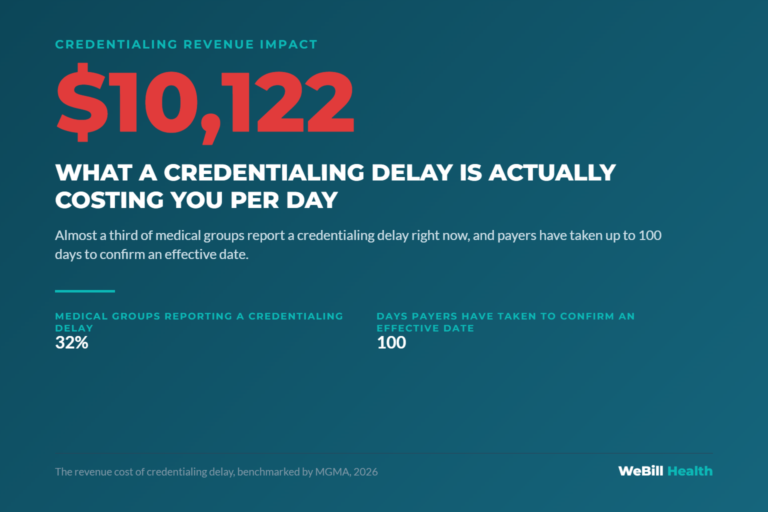
A one day delay in credentialing a new provider costs a medical group roughly 10,122 dollars in lost billing capacity, according to
Read the articleEmail: info@webillhealth.com | Call: +1 (425) 818 9351
Business hours: Monday to Friday, 8am to 9pm EST

WeBill Health manages the full payer enrollment lifecycle, so your revenue cycle starts the moment your practice does.
Credentialing is the single most misunderstood revenue event in a practice's lifecycle. Most providers treat it as a formality. A checklist item. Something that gets handed off to an office manager or a generic credentialing service and tracked through a spreadsheet.
That approach costs practices tens of thousands of dollars in delayed reimbursement, missed market entry windows, and payer enrollment gaps that no one identifies until a claim comes back denied.
WeBill Health built Revenue Velocity Credentialing around a single conviction: a provider who cannot bill is a provider who cannot survive.
Every credentialing delay is a cash flow interruption. Every enrollment gap is a revenue leak. Every CAQH profile that lapses without active management is a denial waiting to happen.
Revenue Velocity Credentialing eliminates all three. Through 24/7 CAQH and PECOS lifecycle management, proactive payer follow up, and specialty specific enrollment strategy, WeBill Health reduces payer enrollment lag by up to 40% and ensures providers are fully pay ready before they deliver their first billable encounter.
Faster Enrollment
The average credentialing timeline for a new provider ranges from 90 to 180 days depending on the payer, the specialty, and how aggressively the enrollment is managed.
The revenue attached to those encounters is either delayed, lost entirely, or at risk of retroactive denial if the credentialing is not airtight.
Traditional credentialing services submit applications and wait. They do not monitor payer queues. They do not proactively follow up on pending enrollments. They do not manage CAQH profile maintenance cycles.
They do not track recredentialing deadlines or flag enrollment gaps before they trigger a billing interruption.
The practices that lose the most revenue to credentialing failures are not making obvious mistakes.
WeBill Health does not complete paperwork. It protects the revenue that paperwork makes possible.
Average Credentialing Delay
Revenue is either delayed, lost, or exposed to denial risk during this window.
Traditional systems wait. Revenue suffers.No proactive follow up. No lifecycle tracking. No enrollment protection.
The result is predictable revenue loss, not random failure.
Before a single application is submitted, WeBill Health conducts a complete assessment.
WeBill Health maintains active oversight of every provider profile.
Applications are submitted with complete and accurate documentation.
Built around the enrollment architecture your specialty requires.
Ongoing management ensures no future revenue disruption.
Most credentialing services measure success by completion.
They submit applications, wait, and mark the process as finished.
There is no connection between credentialing and actual revenue performance.
Delays in enrollment directly impact your ability to collect, but not theirs.
WeBill Health measures success by revenue activation.
The 40% reduction in payer enrollment lag comes from active management and precision.
WeBill Health's revenue share alignment model ties our outcome to your collections.
When your credentialing delays your ability to collect, it delays ours as well.
Every provider enrolled through Revenue Velocity Credentialing has direct access to a dedicated US based credentialing manager who tracks every open enrollment, every pending recredentialing deadline, and every CAQH attestation cycle in their portfolio.
Weekly velocity reports include credentialing status updates alongside A/R and billing performance data so that the full revenue picture is always visible in a single place.
You do not learn about a credentialing gap when a claim denies. You learn about it weeks before it becomes a billing interruption.
Your enrollments move on your timeline. The same credentialing specialist handles every application for your practice, from submission through payer approval.
That specialist tracks your provider roster, your payer mix, and your enrollment history, and owns each enrollment until the payer confirms it.
Revenue Velocity Credentialing is WeBill Health's accelerated payer enrollment service that manages the full credentialing lifecycle through 24/7 CAQH and PECOS monitoring, proactive payer follow up, and specialty specific enrollment strategy.
Standard payer enrollment timelines range from 90 to 180 days depending on the payer and specialty. WeBill Health reduces that timeline by up to 40%.
CAQH is the universal credentialing database most commercial payers use to verify provider information during enrollment.
PECOS is the Medicare Provider Enrollment, Chain, and Ownership System required for providers who bill Medicare.
Seeing patients before credentialing is finalized creates retroactive billing risk and potential denial exposure depending on the payer's policies.
Yes. Payers require recredentialing cycles and CAQH reattestation every 120 days.
Behavioral health, ABA, multistate practices, and surgical specialties carry the highest credentialing complexity.
Yes. We track every license, enrollment and revalidation date for each state a provider bills in, backed by 24/7 CAQH and PECOS lifecycle monitoring. An expert acts on each renewal before it lapses, so a provider who covers patients in several states stays enrolled in all of them.
Yes. We handle Medicaid enrollment and revalidation in each state where you see Medicaid patients, including the Medicaid managed care plans that credential separately from the state program. Medicaid enrollment usually takes longer than commercial enrollment, so we file it first and follow every application until the provider is active.
Every day a provider is not credentialed is a day of earned revenue that cannot be collected. Every CAQH profile that lapses is a claim that could deny.
Revenue Velocity Credentialing is the entry point into WeBill Health's full revenue defense ecosystem.
Request Your Credentialing AssessmentWeBill Health is the revenue defense unit that ensures your practice enters the market pay ready, stays enrolled without interruption, and never loses a dollar because a payer application was sitting in a queue no one was watching.
We earn when you earn. Credentialing is where that commitment begins.
Timelines, stalls and what continuous monitoring changes.
Industry baseline runs around 90 days and often longer. We reduce payer enrollment lag by up to 40 percent against that baseline, so providers are pay ready sooner, with no weeks lost while paperwork moves.
Because it stalls in the gaps. A CAQH attestation lapses, a payer requests a document nobody is watching for, an application sits in a queue with no follow up. Credentialing is slow because nobody is chasing it daily.
Your attestations, expirables and application statuses are watched around the clock by the credentialing team. A lapsed attestation can silently stop payment, and finding out from a denial is finding out too late.
Yes, and this is more common than practices expect. Unbilled encounters accumulate while enrollment is pending. We prioritise the payers carrying the most revenue at risk so the backlog becomes billable in the right order.
Send four fields. We check where your providers actually stand with CAQH and PECOS, which payer applications are stalled, and how much of your revenue is sitting behind them.
Enter a provider’s first date of service and the date you filed. The calculator shows which days Medicare still lets you bill and which days are gone.
Open the credentialing gap calculator
Not ready? Get your Revenue Defense Score in 60 secondsRead the Denial Root Cause PlaybookSee exactly what happens after you send this
Two articles that fit this page, and the paper we send practices that ask about it.
A one day delay in credentialing a new provider costs a medical group roughly 10,122 dollars in lost billing capacity, according to
Read the article →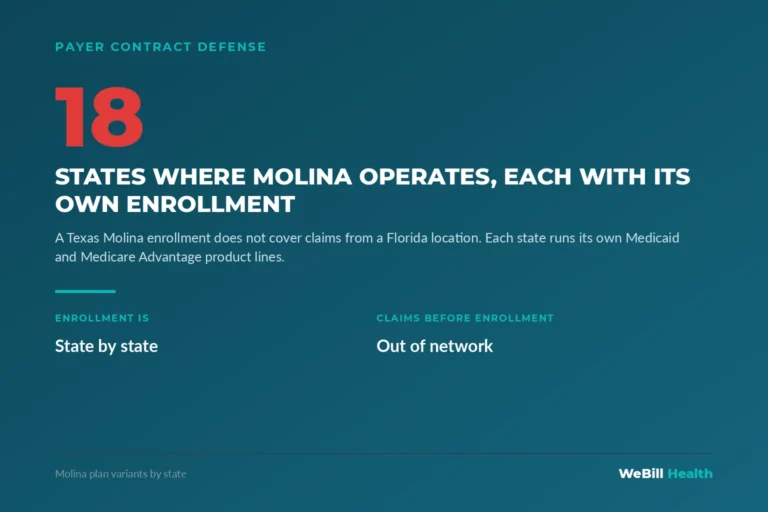
Short answer: Molina runs a separate plan in each state it serves, so enrollment with Molina in Texas leaves a provider out
Read the article →What a new provider's first 90 days cost when enrollment runs late, the Medicare and state rules that set the effective date, and a 120 day onboarding plan with a worksheet.